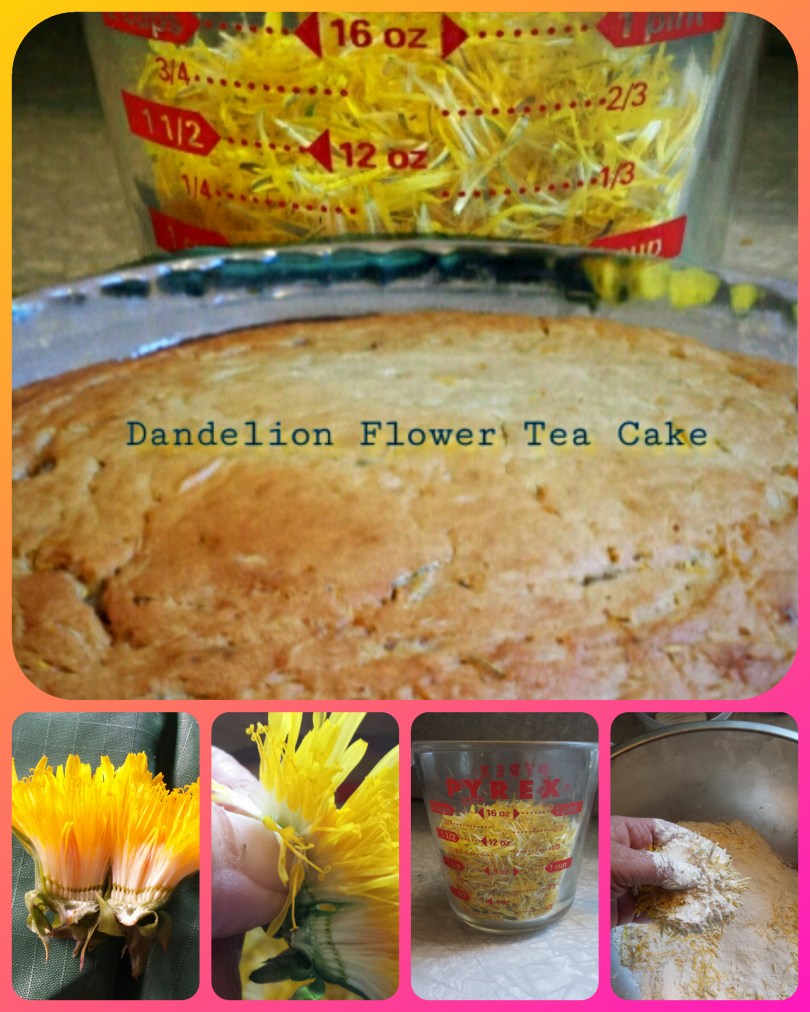
From the humble dandelion….

I could find only scant folklore about the history and use of Dandelion Wine on the internet….Although it has been reported to be of Celtic origin, I am not sure that is true. What I surmise is that there is a great probability that folks have been enjoying this drink for hundreds of years.

European settlers are said to have brought dandelions to the New World. Throughout most of the 19th and early 20th Centuries, Americans revered dandelions as a useful herb. The young leaves and flowers were collected and enjoyed in soups and salads. The roots were harvested and roasted, then ground to make a tasty coffee substitute. People collected the flowers to make delicious dandelion wine.
To make this simple beverage, pick dandelion flowers at midday when they are fully opened. Clean the flower heads to remove the base and green sepals. I pinch the flower heads to break the petals free, or you can split them in half and use your thumb to free the petals from the flower base. I am not a purist, so having a few speaks in the mix does not bother me one bit. It took me only 15 minutes to collect enough flowers for one quart of petals. Cleaning the flowers took a good hour of solid “petal pushing”, LOL! Here’s the recipe:

1 quart dandelion petals
1 gallon boiling water
3 cup sugar
Juice of 2 lemons and 2 oranges
1 medium ginger root, thinly sliced
1 cup of raisins
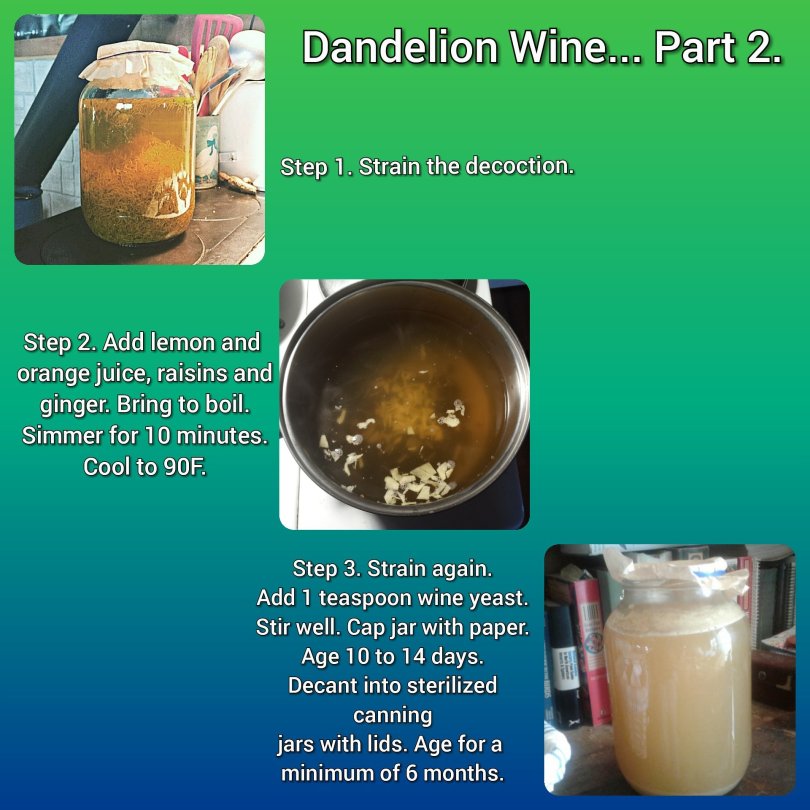
1 package of wine yeastPlace dandelion blossoms in the boiling water. Cover and allow to stand for 48 hours. Strain through cheese cloth and squeeze petals to remove water. Add the raisins, ginger root, the lemon and orange juices to the decoction in a large pan. Place the pan on a stove burner and heat until it boils. Add the sugar, stir to dissolve and simmer for 10 minutes. Remove the pan from the heat and let cool to 90 degrees F (32 degrees C). Strain again. Stir the yeast into 1/4 cup of very warm water.Let this “proof” for 10 minutes. Mix into the cooled decoction and then pour the whole thing into a sterilized 1 gallon crock or jar. Cover with a paper coffee filter, fastened in place with a rubber band. Let the wine ferment in a cool area for 10 to 14 days. Check fermentation after day 10. If ready, then strain through cheesecloth before bottling in quart-sized, sterilized canning jars with lids and rings. Age the wine at least 6 months to a year for best flavor.
For the Love of Cottonwood…

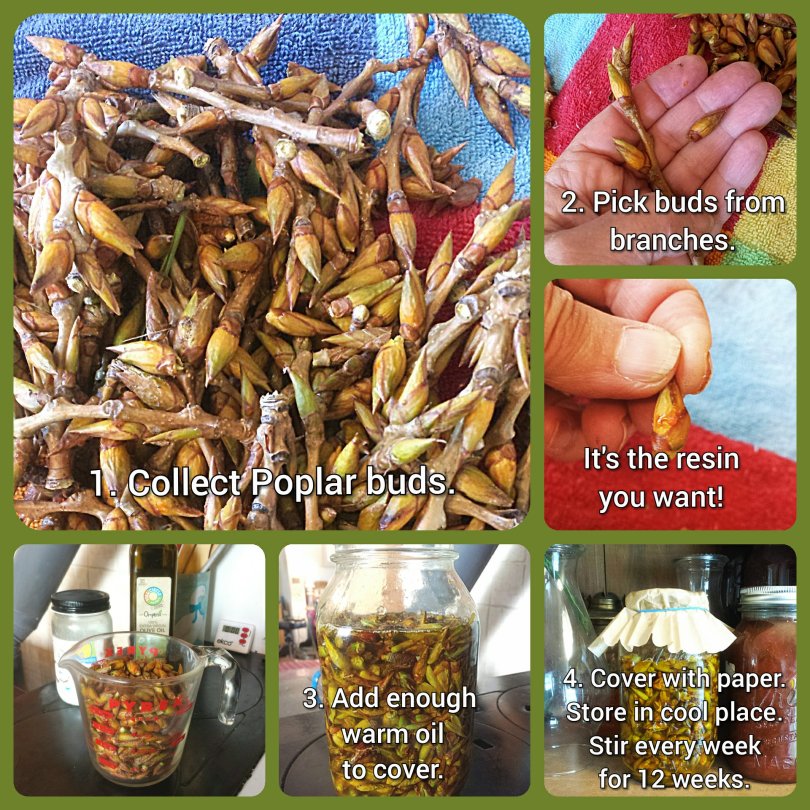
I woke up early this morning, unsettled in Spirit. I decided to head out early (6am) in search of herbal medicine, poplar buds. I knew my window for gathering was very narrow. Daytime temps and soil temperatures are beginning to warm. I needed to catch the poplar buds before they burst into catkins and leaves. I was lucky…. I found some trees near the Pit River and a large Grandmother tree near the office at the local wildlife refuge. Bonanza! The Grandmother tree had dropped lots of small limbs with tightly clasped buds. I filled my pockets and then grabbed a container from the car. I ended up with a solid 2 cups of buds for my use.I have arthritis. Lots of it, but especially in my low back.

I could spend lots of money on over-the-counter rubs, but I prefer to make my own using both Balsam Poplar and Black Cottonwood buds. Poplar buds have been used for centuries by folk here in the United States and is easy to collect in early Spring, before the cottonwood develops its catkins. I can usually find an ample amount on the ground attached to limbs that have blown down in recent storms. This “balm” is known for its anti-inflammatory, analgesic, and anti-rheumatic healing Medicine. The oil or salve helps to relieve the aches and pains of sore muscles, bruises, and arthritis. It’s also a mild sedative, and can be rubbed on your temples at night before retiring.I follow the guidance of Michael Moore, a well known herbalist who has written many books on the wild foraging for medicinal herbs. The summary of medicinal qualities listed below comes from his book “Medicinal Plants of the Pacific West” (1993, Red Crane Books, Santa Fe NM, 359 pg.) under the chapter of “Balsam Poplar. He also covers this subject briefly in the book “ Medicinal Plants of the Mountains West” (1979, Museum of New Mexico Press, Santa Fe NM, 200 pgs.) under the chapter of “Poplar”.The buds contain a soft balsamic resin and a yellow volatile oil. It contains many medicinal properties including silicon, Gallic and malice acids, populism, mannitol, chrysin, tectochrysin, and trichocarpin to name a few. He recommends crushing the buds, adding 4 parts water by volume to 1 part of crushed plant (by weight). Simmer for about 1 hour. Add 1 part volume of vegetable oil, and let cool. The resins and oil are lighter than the water, and will float. Decant the oil off and discard the crushed buds.I prefer a less intensive approach myself… here is my simplified recipe:
1 part cottonwood buds
2 parts extra virgin olive oilFill a glass jar half full with cottonwood buds.
Pour olive oil over the buds and to within 1 inch of the top of the jar.
Cover with a napkin or coffee filter and a rubber band.
Allow to sit and steep for 6 weeks or up to a year or more. The richer the better!Make sure your buds are always covered with oil. This prevents them from molding. Stir or shake the jar every few days for the first few weeks.To use as an oil, strain through a cheesecloth and put the oil into a wide mouth jar. If you want to make a salve, add 2 tablespoons of beeswax to 1 cup of infused oil. You can add 2 capsules of Vitamins E to make it more emollient. Melt the beeswax into the oil on low heat. Watch carefully. You simply want to melt the beeswax. Stir well and pour into a small glass jar or tin… Do not cover with a lid until it is completely cool…… Happy foraging! Please note: People with aspirin sensitivities or tree allergies may not want to use this salve
The Healer of Woundedness…..Willow

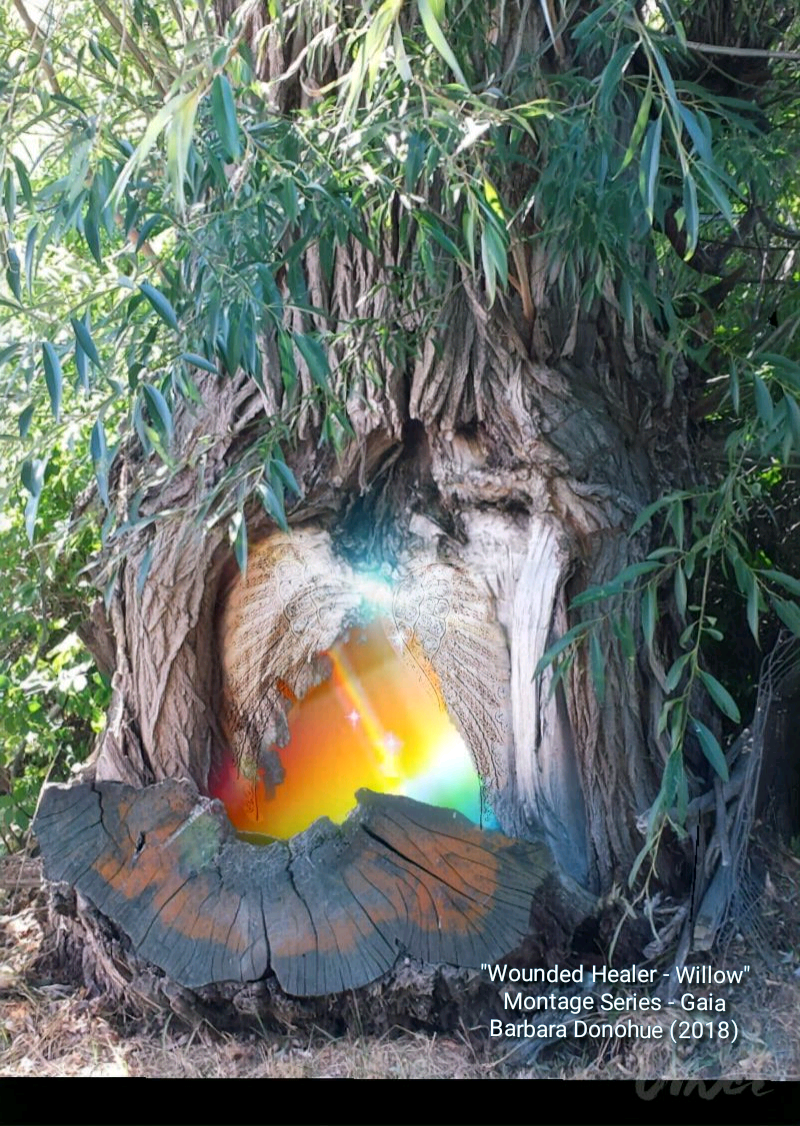
I was visiting with some dear friends this past weekend and came upon a massive willow tree in their yard. The tree was huge, a native species that had stood in the floodplain of the creek all of its long life. I took special notice of a gaping wound located at the base of its thick trunk. Her Wound was located just above Her roots, and I reflected on all of the wounds inflicted on Women….from the past to the present. What I saw within the wounds of this magnificent tree, was the greatest potential for healing I have ever observed as an herb-wife in the plant kingdom.

The Willow tree is a potent, potent ally to women. Has been since ancient times. It is associated with the moon, water, the Goddess and all that is feminine. It is a tree of dreaming, intuition and deep emotions. Symbolically it belongs to the beginning of spring, and is directly related to the celebration of “Imbolc” in early springtime. The essential power of the Willow is to teach us about the Feminine, connect us to our feelings and enhances our capacity to dream. She does this to bring our emotions to the surface for healing. My favorite ancient herbalist, Culpeper, says in his Complete Herbal “The moon owns the willow” and it was known as the witches’ tree and the tree of enchantment. The Internet has volumes of information on this subject under “Willow folklore”….

I created this montage to Honor Her Spirit and great capacity for Healing our wounds as Women in this World…..

Lessons from Rosehips….

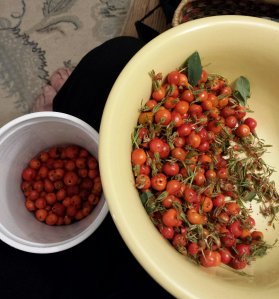
The bright red hips of the wild rose are now ready to harvest where I live. There is simply nothing more satisfying than to gather and ingest the wild gifts of Our Mother Gaia…. especially those that come with medicinal blessings. Rose hips are high in vitamin C. Hands down higher than an orange or other citrus fruit, and are known to reduce inflammation, support the immune system, and counter the effects of stress.

To experience the concept of “beauty”, clean a bowl of rosehips. Each rosehip or “haw”, is unique in its shape, color, luster and scent. Only a few have the physical characteristics of perfection or superficial “beauty”. Some are ovate in shape. Others are obovate, falcate, rhomboid, circular, truncate, acuminate and even pyramid shape. The surface of the hip can be smooth and shiny, granular and dull or even have ridges and other characteristics.

The Strength and Gifts of a Rosehip lie deep in Her cells. Her Power, Her gift of Medicine has nothing to do with what she looks like, or the location of Her emergence on a rose bush. Her Medicine is not dependent on the color or blush of the fruit, nor on softness of Her body. Her Medicine rises … deep in Her flesh, in the flavonoids and cellular walls of Her Being, in the sweet stickiness of Her waters.

One’s Personal Medicine, One’s Gifts for Healing in this World have absolutely nothing, NOTHING to do with what you look like, where you were born, or where you live now. It has nothing to do with your age or place in your family tree, or how much money you have or don’t have. Whether you are educated or not …. The Medicine lies deep, deep within the very walls of your Body and the walls of your Spirit. It already exists … and Rises as you extend your hand to this World and to the woundedness you see before your feet. Feed your Medicine the waters of Life, the freshness of Air, the Earth beneath your naked feet. Turn your mind and Spirit toward the Light of Hope and Vision. See to the Fire that lies within your Breast and release yourself to Love …. and bring healing to yourself and to this World ….

Rosehip and Wild Plum Cordial (Syrup) for Colds and Coughs

1 quart of Wild Rosehips
25 Wild plums (Prunus americana)
5 cups of water
1 cup of sugar
Juice of 1 lemon

Clean the rosehips by removing any flower end and the stem. Rinse in a colander under cool water. Slice open and pit 25 Wild plums. Add to the rosehips. Put ½ of the Rosehips and Wild plums into a blender. Add 1.5 cups of hot water and puree for 1 minute. Pour this into a tall 4 quart saucepan. Repeat with the remaking hips and plums.

Add 2 Cups of boiling water to this slurry in the pot…set on medium high heat and boil for 1 minute. Turn off the heat, cover, and let stand for 12 hours to make a strong decoction.

After 12 hours, strain through a cheese cloth, and gently squeeze to get more decoction. Place the strained juice into a pan and add the sugar. Place on medium heat until it boils. Reduce to a simmer and cook for about 10 to 15 minutes. Remove from heat and add the lemon juice.

Pour into hot, sterilized ½ pint jars or jelly jars. Screw on lids and hand tighten, do not torque. Keep in cool, dry storage. Use within 4 months. If you want a longer shelf life, seal using a water bath canning method. This increases shelf life to 18 months. Add 1 to 2 tablespoons to a tea cup and fill with hot, boiling water…..enjoy

All-powerful against “Wykked Sperytis”

Now that Spring has sprung up here in northeasten California, I find my emotional state to be as varied as the winds that blow across the emerging pear blossoms. Mind you, we have just survived Winter…an elongated, protracted season that invokes its own specialty of emotional torture. I am growing weary of navigating my emotional state based on what the weather is throwing around outside my front door.

I found myself today feeling agitated and anxious. Be it the astrological position of the full moon, or the cold, dark, dreary day….I was fighting a losing battle. So I bundled up and took off on a walk to see what I could find of emerging herbs that might prove useful for my flagging Spirit. Lo and behold I spotted the tender early leaves of catnip! Very little in this World proves as satisfying as a hot cup of fresh herb tea to soothe ones soul. Fresh sprigs of catnip simply immersed in a cuppa hot boiling water both delights the eye and warms the heart. Miss Bardswell in “The Herb Garden” wrote of catmint: “Before the use of tea from China, English peasantry were in the habit of brewing Catmint Tea, which they said was quite as pleasant and a good deal more wholesome”. Catmint is known for its benefits as a springtime tonic, among other graces, yet it did little to soften the edges of my agitated state.

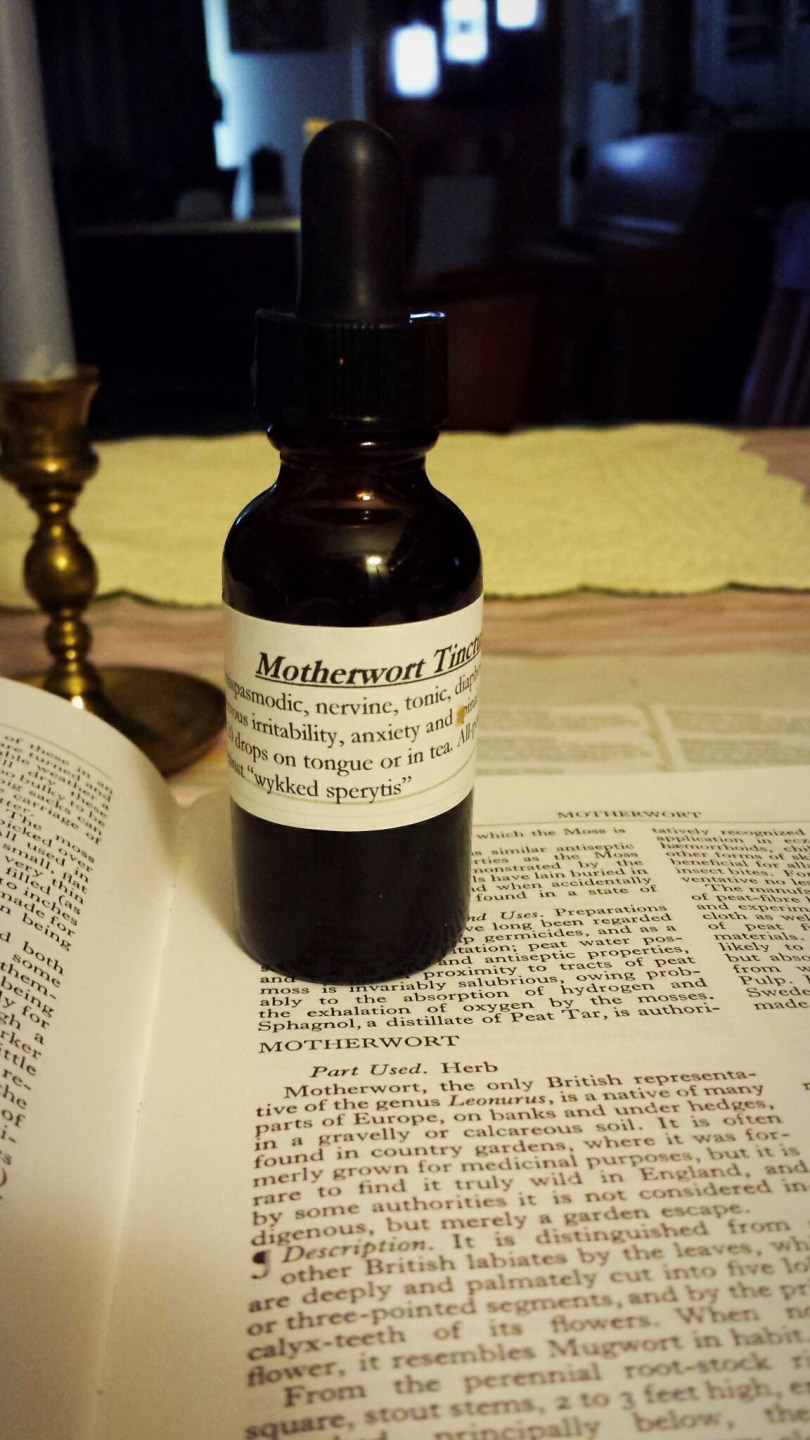
Looking through my herb garden, nothing was showing above ground yet. I returned to the house and began to look through my dried stores from last year. Lemon balm…good choice, but so little of it left. As I pushed the jar to one side, my eyes fell upon my remedy…Motherwort Tincture! Ahhh, the Champion of herbs for a woman’s heart! Personally, I grow it in my garden. It is native to England, but certainly not here. I have to watch it carefully because it reproduces in a most prolific manner and will rudely usurp its neighbors.

In the older herbal texts, Motherwort is described as being used for everything female including an antispasmodic, tonic, and nervine, It stimulates blood flow and induces perspiration as well. It is especially valuable in “female weakness and disorders, allaying nervous irritability and inducing quiet and passivity of the entire nervous system”. Whoa, strong plant juju here…. Yet, it has proven its worth as an overall heart tonic and also in “spinal disease”. Hmmm, think it can regrow collapsed disks or remove spinal stenosis? Need to check that out….

Anyway, Culpepper wrote that “there is no better herb to drive melancholy vapours from the heart, to strengthen it, and make the mind cheerful, blithe and merry”. In another herbal it is listed as THE most powerful herb to use against “wykked sperytis”. By and far the best way to take it is in a tincture. So, 20 drops in a half glass of wine should do the trick. But I choose to keep my “wykked sperytis” wits about me……IMG_20170715_164223

Stories from an Herb-wife – Dandelion Flower Tea Cake

Dandelion Flower Tea Cake
Makes 2 cakes
4 cups flour
4 teaspoons baking powder
1 teaspoon salt
1 1/2 – 2 cups dandelion petals
1/2 cup vegetable oil
3/4 cup honey
2 eggs
2 2/3 cups milk
½ cup of jam Of choice

Mix flour, baking powder, salt and petals in a large bowl. Mix wet ingredients together, add to dry ingredients. Pour into 2 greased and floured cake pans. Bake at 350 degrees for 40 minutes.
Harvesting dandelion petals is a bit tricky. I recommend the following:
Pick flowers on a bright, COOL day, less bugs;
Pick large flowers only because they shrink and wilt quickly;
Split flower heads in half;
Pinch below white area with thumbnail;
Push petals up and pull free gently.

It took about 20 minutes to collect 1.5 cups of petals..

When baking with flower petals, make sure to separate them gently, and coat with flour. I do this by dusting petals with flour BEFORE placing in the bowl…..kind of like coating grated coconut with flour. Use a fork to mix petals into the flour to keep them more evenly distributed….. Mmm mmm, mmm good!inCollage_20180427_202804407

Stories of an Herb-wife – Honeysuckle Syrup


With spring and summer seasons beginning to Rise, I become a totally different beast. I spend hours out of doors sniffing the air, eyes on the ground, rapidly identifying most of the plants that come within view. I admit it, I am a junky…..and have to feed my habit of wildcrafting culinary and medicinal herbs. Botany was my soft spot in academia, and has become a skill I simply adore. I spend hours upon hours simply looking for and harvesting delectable and healing plants.

Honeysuckle flowers are the sweet heralds to the coming of summer. I love their aromatic, sugary scent that fills the air. Last summer I made multiple batches of Honeysuckle Syrup and cough drops and thought you might like the recipe.

Honeysuckle flowers have a variety of medicinal qualities including anti-inflammatory relief for headaches, they reduce fever, are excellent for bronchial spasms and coughs, and protects against viral and bacterial infection. In addition to its medicinal uses, the syrup is mild, and can be used simply as a sweetener in your cup of tea or drizzled over pancakes.

Pick the blossoms in the early morning, preferably before the heat of the day begins. Lay the blossoms out and remove the green sepal end at the base of the flower. Rinse the blossoms gently and place in a small pan. Create an herbal decoction by pouring 2 cups of boiling water over 1 cup of packed honeysuckle blossoms. Let this steep for a minimum of one hour. When cool, place the pot over a low flame and bring to a simmer. Simmer on low for about 30 minutes to reduce the liquid volume to 1 cup. Watch carefully. When completed, strain the decoction and compost the flowers.

To 1 cup of decoction, add 1 cup of sugar and 1 tsp of lemon juice. Bring to a low boil and cook until it begins to thicken. Pour immediately into hot sterilized jars, put on scalded canning lids and hand tighten. Place jars apart by a couple of inches to cool. Sealed syrup last up to a year when stored in a cool, dry place.

I make cough drops by boiling the decoction and sugar to a hard candy stage. I prepare a 9 x 13 inch casserole dish with confectioners sugar. I spread the sugar evenly in the pan and make small depressions using the bottom of a small glass vial. I then pour the candied decoction into the depressions with a small Pyrex measuring cup. Let cool and wrap each drop in wax paper. Store drops in a glass jar with a tight fitting lid.
Enjoy!